
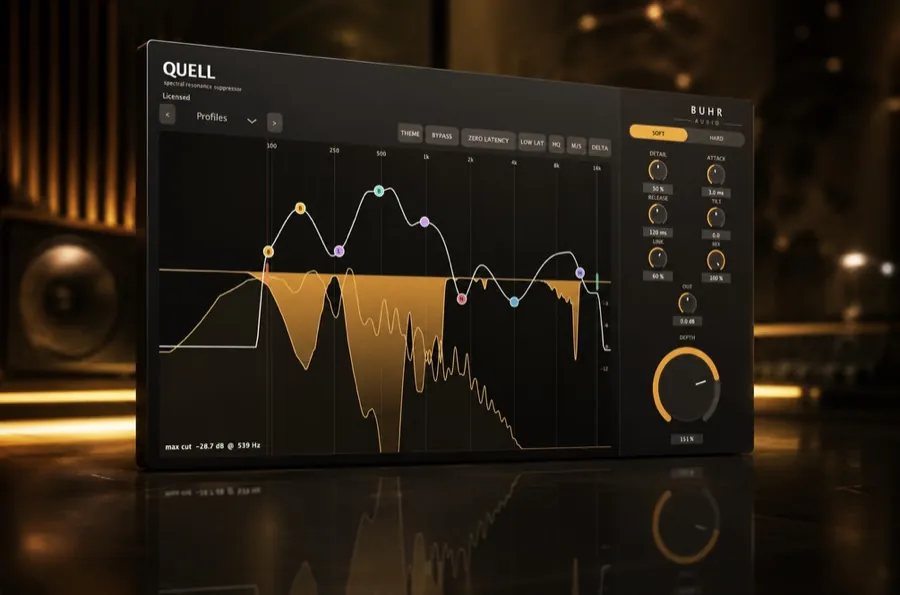
A de-esser turns down one region — sibilance, usually 4–10 kHz — when it gets too loud. A resonance suppressor like Quell works across the whole spectrum and dynamically tames any harsh, ringing resonance wherever it appears, sibilance included. The de-esser is a specialist; the suppressor is the broader tool — and it can usually do the de-esser's job too.
What a de-esser does
A de-esser is a narrow, focused dynamic processor. It watches one band — the sibilant range where "s", "sh" and "t" sounds live — and pulls it down whenever it spikes past a threshold. That's it. Used well, it stops a vocal from spitting without you having to ride a static EQ cut that would dull every word.
The limitation is right there in the design: a de-esser only knows about the band you point it at. If a vocal is also harsh at 3 kHz, or a guitar honks at 900 Hz, the de-esser can't help — that's not its job.
What a resonance suppressor does
A resonance suppressor — also called a spectral resonance suppressor or dynamic resonance EQ — does the same kind of dynamic "turn it down only when it's a problem" trick, but across the entire frequency spectrum at once. It finds resonant peaks anywhere — low-mid boxiness, midrange honk, high-end sizzle, and yes, sibilance — and attenuates each one only while it's actually harsh.
In other words, sibilance is just one of many resonances a suppressor handles. That's why it's the more general tool: instead of one fixed band, it follows every troublesome peak at the same time.
Try a free resonance suppressor
Quell tames harsh resonances across the whole spectrum — $2, pay what you want. AU & VST3 for macOS & Windows.
Get Quell · $2Side by side
- Frequency range
- De-esser: one band (sibilance). Suppressor: the full spectrum.
- Targets
- De-esser: harsh "s" sounds. Suppressor: any harsh, ringing resonance.
- Number of peaks
- De-esser: one region at a time. Suppressor: many moving peaks at once.
- Best for
- De-esser: dedicated, heavy sibilance control. Suppressor: general de-harshing on any source.
- Works on
- De-esser: mostly vocals. Suppressor: vocals, guitars, drums, cymbals, busses.
When to use which
- Reach for a resonance suppressor when a source is broadly harsh, when harshness moves around the spectrum, or when you want one tool that handles boxiness, honk, sizzle and sibilance.
- Reach for a de-esser when a vocal needs aggressive, dedicated sibilance taming and you want a single, simple control focused only on the "ess".
- Use both only when a suppressor has handled the overall harshness but a stubborn vocal still needs extra, focused de-essing on top.
For most people, a good resonance suppressor covers both jobs. For a hands-on vocal example, see how to remove harsh resonances from vocals.
Can a resonance suppressor replace a de-esser?
Usually, yes. Because a full-spectrum suppressor already tames harsh peaks in the sibilant range, it handles de-essing as part of its normal work — often more naturally, since it only acts on the exact peaks that ring rather than ducking a whole band. Keep a dedicated de-esser in your back pocket for the rare vocal that needs heavy, surgical sibilance control, but you'll reach for it far less than you'd think.
One tool for harshness everywhere
Get the $2 Quell spectral resonance suppressor and tame sibilance, boxiness and ring with one plugin.
Get Quell · $2FAQ
What is the difference between a resonance suppressor and a de-esser?
Can a resonance suppressor replace a de-esser?
Do I need both a de-esser and a resonance suppressor?
Written by Reinhardt Buhr, a Hamburg-based live-looping multi-instrumentalist and the developer behind Buhr Audio. Quell is his $2 spectral resonance suppressor — download it free here.