
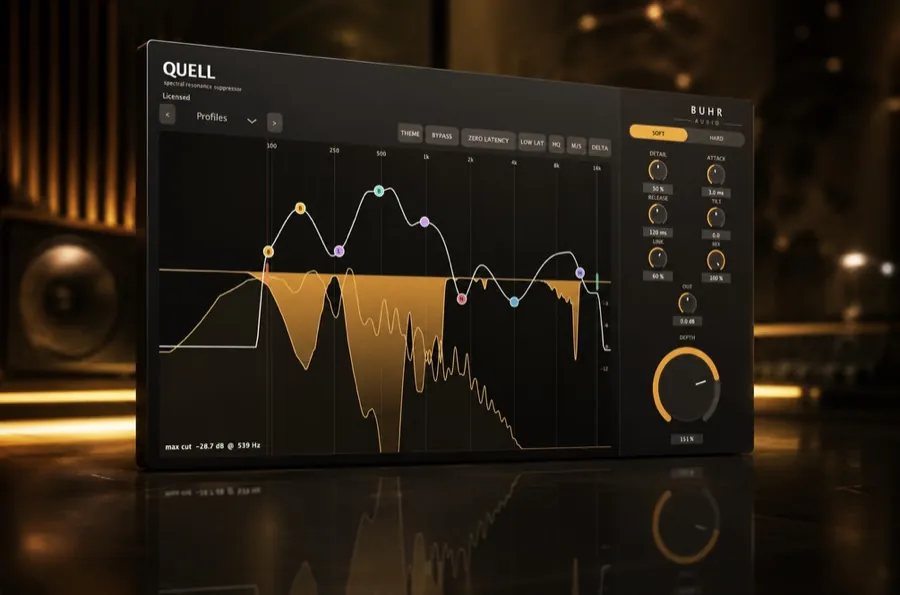
A dynamic EQ reacts at fixed bands you choose; a resonance suppressor automatically finds and ducks resonant peaks across the whole spectrum as they pop up. Use dynamic EQ for known, specific problems; use a resonance suppressor for fast, broadband smoothing of harshness and ringing. Quell does the latter, free.
How a dynamic EQ works
A dynamic EQ is an equaliser whose bands only act when the signal crosses a threshold. You place a band at a specific frequency, set a threshold, and it cuts (or boosts) only when there's enough energy there. It is precise and surgical: you decide exactly where and how much. The catch is that you have to find every problem frequency and set up a band for each one.
How a resonance suppressor works
A resonance suppressor analyses the whole spectrum continuously and automatically identifies frequencies that ring out or jump above their neighbours — the definition of a resonance. It then ducks just those peaks, just when they occur, across dozens of micro-bands at once. You don't tell it where to look; it finds the resonances for you and smooths them dynamically.
The key difference
- Dynamic EQ
- Fixed bands you place manually. You find the problem; it controls it precisely.
- Resonance suppressor
- Automatic, full-spectrum detection. It finds the problems and tames them for you.
- Best for (dyn EQ)
- Known, specific issues — a ringing 3.2 kHz, a boomy 120 Hz, a harsh cymbal band.
- Best for (suppressor)
- Broadband harshness, boxiness and ringing that move around — vocals, drums, busy busses, mastering.
When to use which
Reach for a dynamic EQ when you can clearly hear and locate a single recurring problem and want total manual control. Reach for a resonance suppressor when the harshness is spread out or constantly shifting, or when you just want to smooth a source quickly without hunting for every frequency. In practice, most people use a suppressor for fast cleanup and a dynamic EQ for the one or two stubborn spots that remain.
They work brilliantly together
These aren't rivals. A common pro workflow: let a resonance suppressor like Quell smooth the overall harshness and ringing, then add a dynamic EQ band for any specific frequency that's still poking through. If you came here from the Soothe debate, see the best free Soothe2 alternative and free dynamic resonance suppression explained.
Try Quell — $2
A free spectral resonance suppressor that finds and tames harsh, ringing resonances across the whole spectrum. AU and VST3 for macOS and Windows.
Get Quell · $2FAQ
Is a resonance suppressor just a dynamic EQ?
Do I need both a dynamic EQ and a resonance suppressor?
Is there a cheap resonance suppressor?
Written by Reinhardt Buhr, a Hamburg-based live-looping multi-instrumentalist and the developer behind Buhr Audio. Quell is his $2 spectral resonance suppressor — automatic, full-spectrum resonance control for $2. Download it free here.