
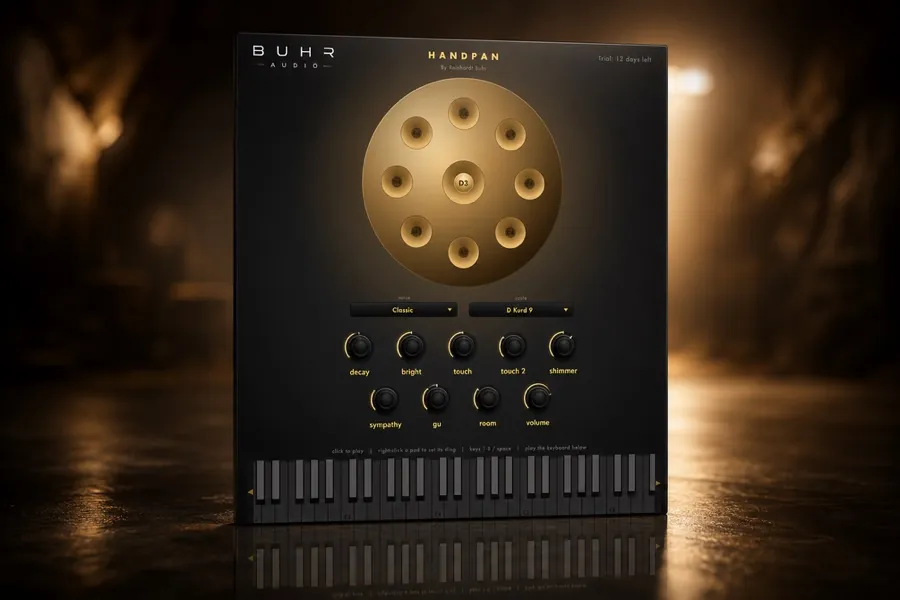
'Hang' (or Hang drum) is a specific, trademarked instrument made by PANArt in Switzerland. 'Handpan' is the generic name for the whole family of instruments it inspired. They sound essentially the same to most ears, and the thing producers actually want is an expressive, playable handpan in their DAW — like the Buhr Audio Physical Modelling Handpan.
A quick bit of history
In 2000, the Swiss company PANArt created an instrument called the Hang (German for 'hand'). It was a steel sound-sculpture you played with your hands, and it was unlike anything before it. It became wildly sought-after — so much so that other makers around the world began building similar instruments.
Why 'hang drum' is technically a misnomer
Two things: first, PANArt never called it a 'drum' — they consider it a melodic, tuned instrument, not a percussion drum. Second, 'Hang' is their specific product. So when people say 'hang drum', they usually mean the broad family of instruments, not the original PANArt Hang. The agreed-upon generic term for that family is handpan.
Do they actually sound different?
To most listeners, no — the defining sound (the hypnotic, ringing, resonant steel) is common to the whole family. Different makers and different steels have their own voice, just like different guitar brands, but 'handpan' and 'hang drum' refer to the same kind of instrument and the same beloved sound.
What this means for producers
If you are searching for samples or a plugin, search both terms — you will find the same thing. What matters far more than the name is whether the instrument is expressive: does it respond to your touch, do notes ring sympathetically, does the decay bloom naturally? Those qualities are what make it sound real, and they are exactly where a good handpan plugin earns its place.
Try the Physical Modelling Handpan
A fully modelled, playable handpan — no samples. $9 one-time. AU and VST3 for macOS and Windows.
Get the HandpanGetting the sound in your DAW
You do not need to own (or mic) a steel handpan to use the sound. The Physical Modelling Handpan generates it live with true sympathetic resonance and authentic scales, so you can play and record handpan parts on a MIDI keyboard. New to it? See how to use a handpan VST in your DAW and a breakdown of the available handpan scales.
FAQ
Is a hang drum the same as a handpan?
Why is it called a hang drum?
Can I get a hang drum VST?
Written by Reinhardt Buhr, a Hamburg-based live-looping multi-instrumentalist and the developer behind Buhr Audio. The Physical Modelling Handpan is his fully-modelled handpan instrument — call it a hang drum if you like — try it free here.