
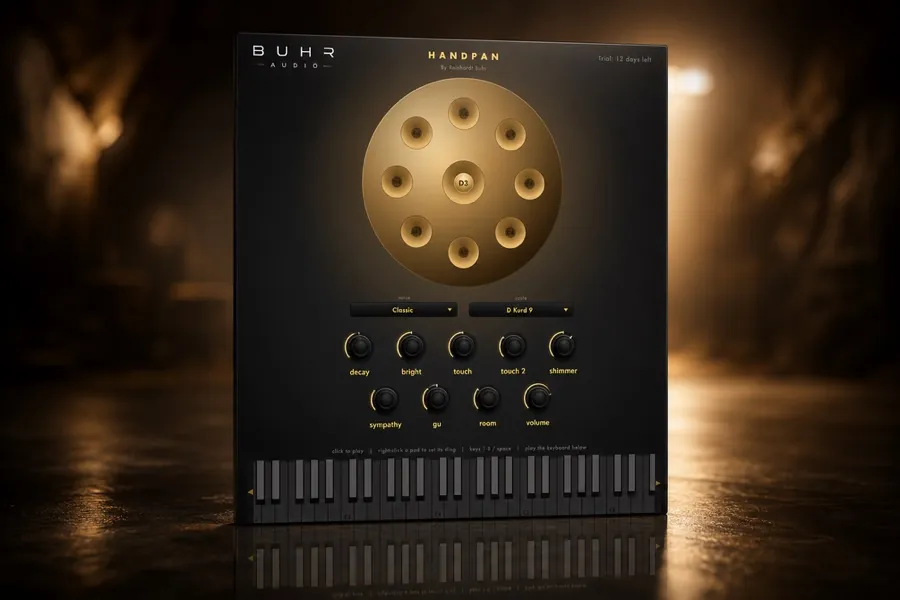
A physical modelling handpan recreates a handpan by simulating the physics of the steel shell in real time — how it vibrates, how the notes ring into each other, how the sound blooms and decays — instead of playing back recorded samples. Because the sound is generated live, it responds to how you play and sounds different on every strike, just like the real instrument. The Buhr Audio Physical Modelling Handpan works this way.
Samples vs physical modelling, simply
There are two fundamentally different ways to make an instrument sound in software.
Sampling is recording. Someone records the real instrument — a note at a few volumes — and the plugin plays those recordings back when you press a key. It's like a photo album: accurate snapshots, but fixed. Press the same key the same way and you hear the exact same recording every time.
Physical modelling is simulation. Instead of recordings, the software contains a mathematical model of how the instrument works — the material, the shape, the way energy moves through it. When you play a note, the model calculates the resulting sound from scratch. It's less like a photo and more like a flight simulator: you're not replaying a recording of a flight, you're flying.
Why this matters so much for a handpan
For some sounds, samples are perfectly fine. The handpan is not one of those sounds. Its entire character comes from interaction and nuance:
- Sympathetic resonance. Strike one note and the rest of the shell rings along in sympathy. On a real handpan this is constant and musical; with isolated samples it simply isn't there.
- Dynamics that change tone. A gentle tap and a firm strike don't just differ in volume — the timbre, attack and overtones change completely. Models capture this as a continuous range; samples jump between a few fixed layers.
- No two strikes alike. Real playing is full of micro-variation. A model produces a fresh result every time; samples repeat, and the ear notices the "machine-gun" effect quickly.
- Long, blooming decays. Notes overlap and breathe into each other. A model lets them interact naturally instead of stacking identical tails.
Put simply: the handpan's soul lives in the things a fixed recording throws away. That's why we built ours as a model. For the buyer's-guide version, see the best handpan VST plugin.
Hear the difference
The Physical Modelling Handpan is fully modelled — no samples. $9 one-time. AU & VST3 for macOS & Windows.
Try it freeThe trade-offs, honestly
- Realism & feel
- Modelling wins for expressive, interactive instruments — it responds to you in real time.
- Footprint
- No multi-gigabyte sample download. A model is tiny on disk and light on RAM.
- CPU
- Modelling uses processing power instead of disk streaming, but a well-built model runs easily on modern machines.
- Tweakability
- Because the sound is generated, you can shape the physics — decay, brightness, resonance, room — not just EQ a recording.
What you can shape on a modelled handpan
Because nothing is "baked in," a modelled handpan hands you controls that simply don't exist on a sample player. On the Buhr Audio Physical Modelling Handpan you can dial decay, brightness, touch sensitivity, shimmer, sympathetic resonance, room and level, and choose authentic handpan scales such as D Kurd. You're not editing a recording after the fact — you're changing the instrument itself, then playing it.
Play a living instrument
Get the Physical Modelling Handpan for $9 and feel the difference physical modelling makes on a real handpan part.
Get it nowFAQ
What is a physical modelling handpan?
Is physical modelling better than samples for a handpan?
Does a modelled handpan use more CPU than samples?
Written by Reinhardt Buhr, a Hamburg-based live-looping multi-instrumentalist and the developer behind Buhr Audio. The Physical Modelling Handpan is his fully-modelled handpan instrument — try it free here.