
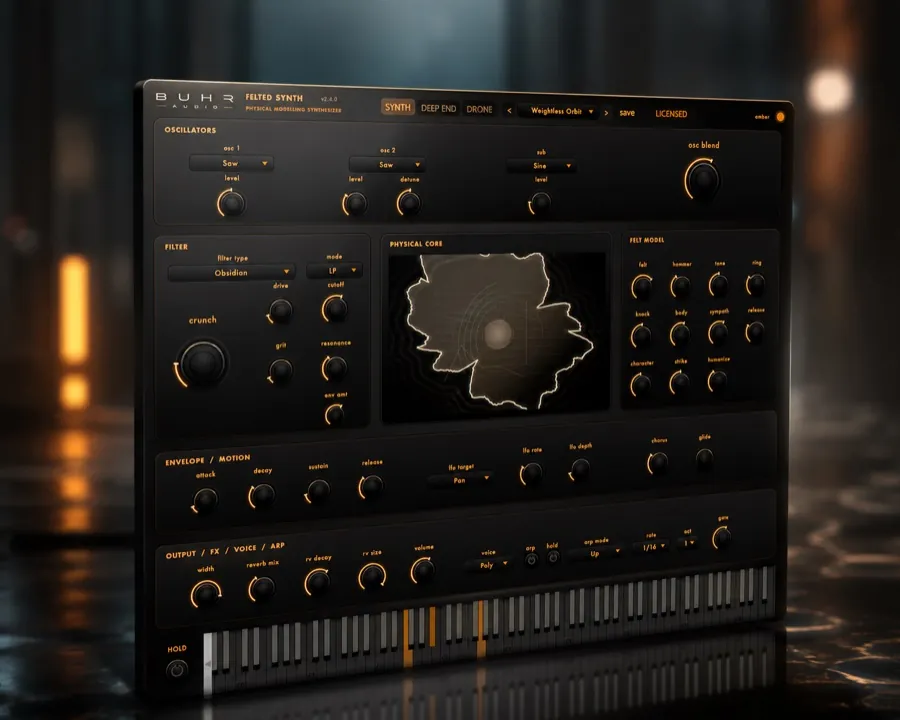
A felt piano is a piano with felt between the hammers and strings — soft, muted, intimate. The best felt piano VST for you depends on whether you want a snapshot of one instrument (samples) or an expressive, shapeable one (a physical model). Felted Synth by Buhr Audio is a physically-modelled felt piano fused with a six-character analog-style filter, bowed strings and an evolving drone engine. AU, VST3 & Standalone for macOS. $5 one-time.
What is a felt piano?
On an upright piano, the practice pedal (sometimes called the moderator or celeste pedal) lowers a thin strip of felt between the hammers and the strings. Every note now has to speak through fabric: the attack softens, the brightest overtones are muted, and what's left is a warm, breathy, almost whispered version of the piano.
What began as a way to practice without waking the neighbors became a sound in its own right. Recorded up close, a felt piano brings the listener inside the instrument — you hear the softness of the hammer, the intimacy of a quiet room. That's why the felt piano has become a signature color of modern film and TV scoring, neo-classical music, ambient and lo-fi beats: it sounds personal in a way a concert grand rarely does.
Sampled vs physically-modelled felt pianos
Felt piano plugins come in two fundamentally different flavors, and it's worth understanding the trade-off before you choose one.
- Sampled felt piano
- A library of recordings of one real, felted instrument in one room. You get that exact piano's character, captured in detail — but the sound is fixed. Dynamics step between recorded velocity layers, and libraries can run to many gigabytes on disk.
- Physically-modelled felt piano
- The instrument is computed in real time — the interaction of hammer, felt and string is generated, not played back. Dynamics are continuous rather than layered, every note responds consistently, the install stays small, and the model can be pushed into places no recording can go.
To be fair to both: if your goal is the precise sound of one specific, beautifully recorded instrument, a good sample library delivers exactly that. A physical model trades the fixed snapshot for expressiveness and flexibility — it behaves like an instrument under your fingers, and it can morph beyond realism into pads, textures and soundscapes. For writing and sound design, that flexibility is often worth more than the snapshot.
What to look for in a felt piano plugin
- The core tone
- Soft attack, muted highs, warmth without mud. If the basic felt sound doesn't move you at pianissimo, nothing else matters.
- Dynamics
- The felt piano lives between whisper and mezzo. Look for a convincing, continuous response to soft playing, not an audible jump between layers.
- Tone shaping
- Filtering or voicing controls that take the sound from close and dark to open and airy without reaching for third-party EQ.
- Beyond the piano
- Cinematic and ambient work usually needs more than keys — sustained textures, drones and swells that sit under the piano. Extra sound layers in the same instrument save a lot of stacking.
- Footprint
- Disk space and load times matter if the instrument lives in your template. Modelled instruments have a natural advantage here.
- A fair price
- The full instrument for a one-time $5 — no subscription, no crippled tier, lifetime updates included.
Try Felted Synth
A physically-modelled felt piano with a six-character analog filter, bowed strings and an evolving drone engine. $5 one-time. AU, VST3 & Standalone for macOS.
Get it nowFelted Synth: a felt piano that goes further
Felted Synth by Buhr Audio is a physically-modelled felt piano synthesizer — a true model, not a sample library. The felt piano at its core is generated live, so it responds to your playing continuously, from barely-touched pianissimo upward. But the reason it earns a place in this guide is what it's fused with:
- A six-character analog-style filter — shape the felt tone from soft and intimate to bold and colored, all inside the instrument.
- Bowed strings — sustained, singing lines that complement the piano's soft attack.
- An evolving drone engine — slow-moving beds and underscore that turn a chord into an atmosphere.
The result covers everything from whisper-soft upright to cinematic soundscape in one instrument. It ships as AU, VST3 and a Standalone app for macOS 11 and later (Apple Silicon & Intel — currently macOS-only), costs $5 as a one-time purchase with lifetime updates, and has no watermark and no locked features.
Craft tips: getting the most from a felt piano
- Give it a room. The felt tone is dry and close by nature — a soft room or shimmer reverb places it in a space. It pairs beautifully with Aurora, our free shimmer reverb.
- Filter down for lo-fi. A gentle low-pass takes the felt sound straight into lo-fi territory; in Felted Synth the analog-style filter characters do this inside the instrument.
- Layer a drone underneath. A quiet, evolving drone below a sparse felt progression adds weight and tension without adding notes.
- Use the bowed voice for sustain. Felt piano notes bloom and fade quickly — let bowed strings carry the long lines the piano can't hold.
- Play quieter than you think. The magic of a felt piano lives at low velocities. Leave space, and let the softness be the feature.
Hear it in your own session
Get Felted Synth for $5 — no watermark — and play the felt piano, bowed strings and drones on your own tracks.
Get it nowFAQ
What is a felt piano?
Is a sampled or physically-modelled felt piano better?
What is the best felt piano VST?
Does Felted Synth run on Windows?
Written by Reinhardt Buhr, a Hamburg-based live-looping multi-instrumentalist and the developer behind Buhr Audio. Felted Synth is his physically-modelled felt piano — try it free here.