
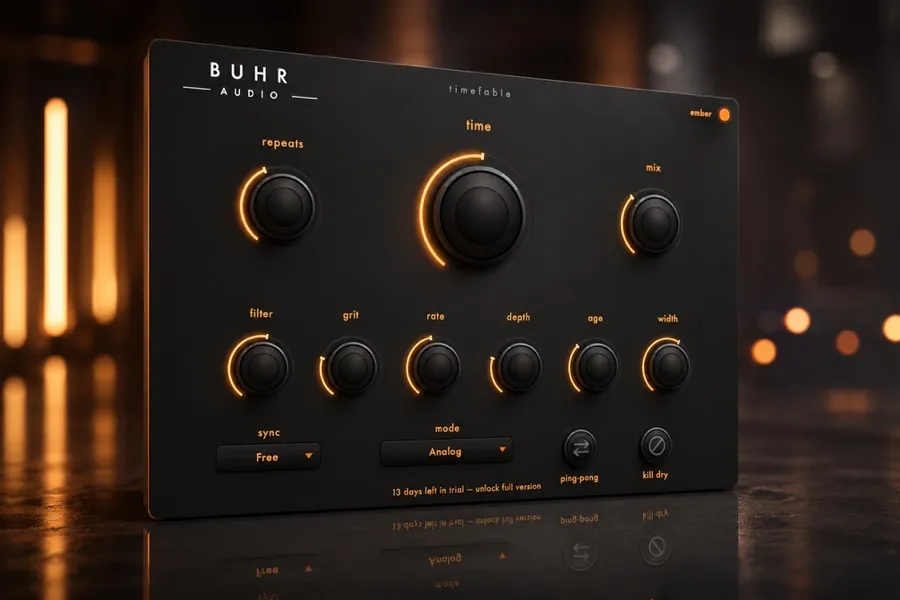
Tape delay is warm and saturated with wow & flutter. BBD (bucket-brigade) is darker, grittier and more lo-fi as it decays. Digital is clean and precise, repeating your sound exactly. Tape and BBD color the repeats; digital keeps them transparent. An analog-modelled delay like TimeFable gives you tape and BBD in one plugin, and can run clean too.
Tape delay
The original "studio" echo. The signal is recorded onto a moving loop of tape and played back a moment later by a separate head. Because it's real tape, every repeat picks up saturation, a gentle high-frequency roll-off, and wow & flutter — tiny speed variations that add a singing, three-dimensional movement. Tape is the warm, lush, slightly dreamy end of delay, and it's brilliant for vocals, dub feedback throws and vintage ambience.
BBD (bucket-brigade) delay
BBD is the analog-chip approach: the signal is passed along a chain of tiny capacitors, "bucket by bucket," each one handing the charge to the next. That process is lossy by nature, so repeats get darker and grittier as they fade, with a distinctive lo-fi smear. BBD is the moody, characterful sibling of tape — perfect when you want echoes with grit and attitude rather than polish.
Digital delay
Digital delay stores the signal as data and plays it back exactly, on time, every time. No saturation, no drift, no darkening unless you add it. That makes it the cleanest and most precise option — ideal for tight rhythmic delays, surgical timing, and any moment you want the repeat to be a transparent copy rather than a flavour. Modern "analog" plugins are digital under the hood, but they deliberately model tape/BBD behaviour to add the character back.
Side by side
- Tape
- Warm, saturated, wow & flutter, darkens as it fades. Lush and vintage.
- BBD
- Darker, grittier, lo-fi smear on the tail. Moody and characterful.
- Digital
- Clean, precise, no coloration. Transparent and tight.
- Best for
- Tape: vocals & dub. BBD: guitars & texture. Digital: rhythmic, surgical delays.
Get tape & BBD in one plugin
TimeFable models both, with hands-on modulation and tone shaping. $4 one-time. AU & VST3.
Get TimeFableWhich should you use?
- Want warmth and vibe? Reach for tape — lush repeats that sit behind a vocal or guitar.
- Want grit and mood? BBD gives darker, characterful echoes that add texture.
- Want precision? Digital (or a clean analog setting) keeps rhythmic delays tight and transparent.
- Want all three? An analog-modelled delay covers the warm end and can be dialled clean for the rest.
For the buyer's-guide take on choosing a warm one, see the best analog delay plugin.
One plugin, every flavour
TimeFable was built so you don't have to choose. It models both tape and BBD character, with saturation, filtering and modulation you can push from subtle to extreme — and dial back for a tighter, cleaner repeat when you want it. Tempo-sync or free time, ping-pong stereo, and self-oscillating feedback mean one plugin covers slapback, dub, ambient washes and rhythmic delays. It runs as AU and VST3 on macOS 11+ and Windows 10/11, a one-time $4.
Hear the three flavours yourself
Get TimeFable for $4 and A/B tape, BBD and clean repeats on your own track.
Get it nowFAQ
What is the difference between tape, BBD and digital delay?
Which delay type is the warmest?
Can one plugin do tape, BBD and digital delay?
Written by Reinhardt Buhr, a Hamburg-based live-looping multi-instrumentalist and the developer behind Buhr Audio. TimeFable is his warm analog-modelled delay — try it free here.